People believe colleges and universities matter. In fact, Ologie’s own research found that 77% of people believe that higher education makes an important contribution to society.
But believing an institution matters and believing it deserves your money are two very different things. That gap is becoming increasingly visible in advancement & fundraising campaigns: Fewer alumni are choosing to participate in giving at all.
Although philanthropic support continues to rise overall, CASE’s 2025 industry data showed a fourth consecutive year of decline in the number of alumni donors, even as total giving reached a record high. And giving is extraordinarily concentrated: 89% of funds received last year came from just 2% of donors. Research from the Lilly Family School of Philanthropy adds another warning sign: Giving to education is less common among younger donors.
That isn’t a sustainable trajectory.
So how can advancement & fundraising campaigns inspire more donors—and, let’s face it, younger ones—to give?
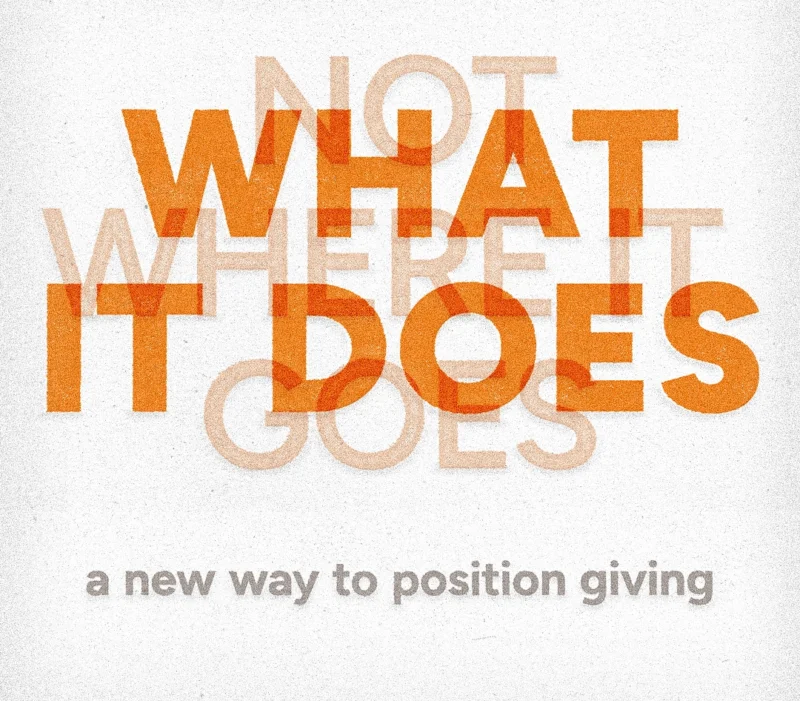
It may require a fundamental shift in how your institution frames the ask: Stop positioning your institution itself as the cause, and start positioning it as the way for donors to advance the causes they already care about.
To make that change, it helps to recognize two ways that traditional advancement messaging can work against donor motivation.
Mistake 1: Focusing on the wrong protagonist.
Many advancement communications lead with the institution: its mission, its priorities, its campaign goals. But that makes your university the protagonist of the fundraising story, when donors are likely more interested in what happens with the funds. They want answers to questions like: Who will this help? What problem does it solve? What will it let someone do?
For younger alumni, particularly those still paying off student loans, framing the ask as “giving back” can be awkward. From their perspective, they may feel like they’re still paying you.
And if your institution has a healthy endowment, phrases like “invest in our future” or “support our mission” can prompt a skeptical assessment of your finances. As a higher ed professional, you understand that an endowment is not a checking account — but donors usually don’t. As trust in institutions continues to erode, your potential donors may be quick to question why a college with a fund worth hundreds of millions needs their money.
That doesn’t mean the emotional connection alumni have with their college years is irrelevant. Nostalgia can be a powerful way to reopen that connection, especially when it reminds donors of the possibility they once felt and invites them to create it for someone else.
Mistake 2: Naming the transaction instead of the outcome.
Giving communications also tend to organize their messages around funds or schools or campaign pillars, because that’s how the money is tracked. But that’s an internal necessity, not something that motivates donors.
Pillars and priorities tell donors where the money is headed. It rarely tells them what changes as a result. When we organize the pitch around internal categories, the reasons to give (which can be genuinely moving) often get buried under flat, forgettable language.
Instead, build advancement & fundraising campaigns around the cause.
Leading with the cause changes the rationale for giving. The institution’s need is no longer the primary reason to act. The question shifts from “Does this university need more money?” to “Is this an outcome I want to help make possible?” And with that shift, you have a greater chance of resonating with younger donors.
Consider these findings:
- Gen Z and Millennial donors tend to focus their giving on issues rather than specific organizations.
- Gen Z and Millennial respondents aspire to be considered advocates (63%) and changemakers (55%), while only 27% connect with the traditional label philanthropist. Passion for a specific cause or issue is among their primary motivations for charitable involvement.
- Nearly 70% of Gen Z respondents said impact reporting could motivate them to increase their giving.
In other words, younger donors may be less interested in supporting institutions as an expression of loyalty and more interested in seeing themselves as participants in change.
Note that this isn’t simply an exercise in renaming campaign pillars. Calling a scholarship fund “Opportunity” while making the same self-centered case won’t change much.
Cause-first fundraising starts further upstream: with the change a donor wants to see in the world, the people affected by it, and the role your institution is uniquely equipped to play in making that change happen. Build the case for support from the outcome backward, rather than starting with a campaign priority and searching for a more compelling way to describe it.
None of this diminishes the institution itself. In fact, it makes the institution’s role clearer. The research, the infrastructure, the faculty expertise, the student talent, the decades of continuity — these are what give universities the capacity to take on problems that few individuals can address alone. That capacity is where donors find value.
Give through a university, and funding a lab becomes a way to advance a cure. Financial aid becomes a way to widen opportunity. A language program becomes a way to preserve a culture. A business school initiative becomes a way to strengthen a city’s economic future. Support for faculty scholarship becomes a way to protect inquiry and academic freedom.
Health. Opportunity. Culture. Freedom. Community. These are causes people already care about and give toward. Universities are already doing consequential work in every one of them. The opportunity for advancement & fundraising campaigns is to help donors see your institution not as the destination for their generosity, but as the channel through which their generosity reaches the world.
Get that right, and your institution stops being the beneficiary donors are asked to believe in. Instead, you become the capable partner that turns their motives into something real.
- Source: The Next Generation of Philanthropy. Lilly Family School of Philanthropy, Indiana University Indianapolis, January 2025.
- Source: Shaping Tomorrow: How Gen Z and Millennials View Charitable Giving. Foundation Source Philanthropic Services, 2024.
- Source: Gen Z at the Table. Blackbaud Institute, May 2024.