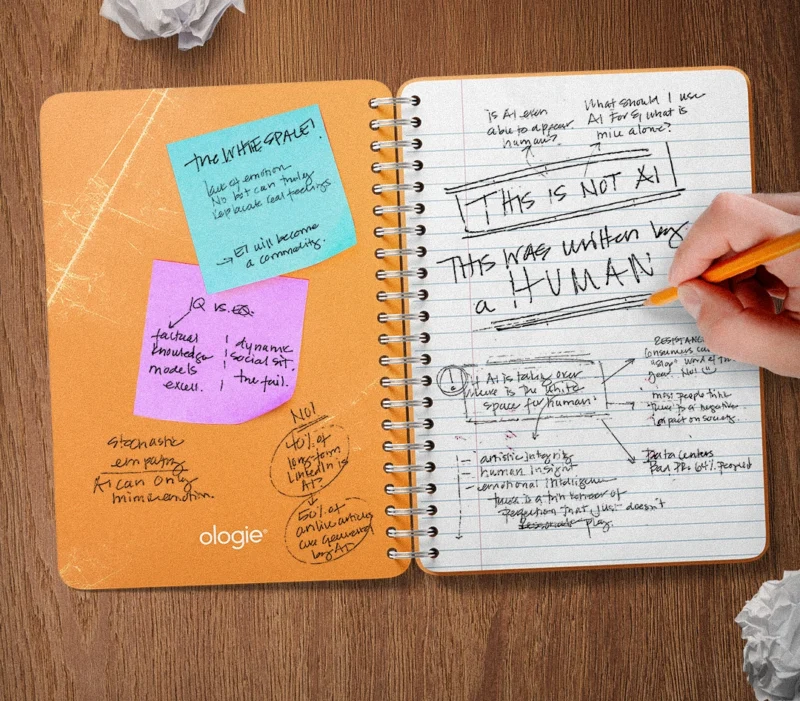
This was written by a human.
Something that needs to be said when recent studies have classified more than 40% of long-form LinkedIn posts and roughly half of sampled online articles as AI-generated. This meteoric rise in generated content makes sense, considering more people have access to more, higher-quality tools. At the same time, the general discourse around AI has been fueled by fear, as companies like Anthropic seem to disrupt new industries every week. Which begs the question: If robots are really taking over, where is the white space for humans? And what does that mean specifically for the future of the branding and marketing industry?
To answer that question is to answer another: why would Anthropic, the company building some of the world’s most capable AI models, hire creative agency Mother to build a global brand campaign around the public’s biggest concerns about AI? (OpenAI offers another compelling cog in this wheel, but for the sake of brevity they will get a temporary pass).
Abundance vs. Resistance
The answer starts with a fact that even Anthropic is aware of: While this AI abundance has created a near-endless supply, it isn’t necessarily translating to consumer demand. People have been inundated with so much generated junk that Merriam-Webster named “slop” the word of the year in 2025. Even the data shows signs of resistance: 40% of U.S. adults and 48% of 18- to 29-year-olds think that AI will have a negative impact on society. The PR is even worse for the data centers that power these models: 64% view their rapid construction as a negative.
A signal that sits closer to the creative industry is the current mindset of artists. Well-known creative minds like Guillermo del Toro and Jack Antonoff have deemed algorithms as the antithesis of artistic integrity. “No AI used” is becoming a badge of honor and proof of quality. A majority of young adults seem to be on the same page, with 66% saying they would like a painting less if they found out it was produced using AI, and 53% saying the same about a song. The revelation of AI intervention is invoking a similar reaction to finding out how hotdogs are made: “that’s gross.”
Some brands are starting to take note of this trend. In early 2026, Hermès commissioned artist Linda Merad to transform its website with 12 hand-drawn scenes. You could see the paper grain, the irregular lines, the uneven coloring, and all of the very imperfections algorithms are trained to erase. And that was the point. In a sea of generated sameness, proof of human, hand-made creation felt distinctive, even luxurious. Hermès is one signal that the perceived threat to creatives may also be creating an opportunity.
And if humans are craving human creations, that’s a captive audience.
IQ vs. EQ
Anthropic is also aware of the deficiencies in its models. Thanks to the benchmarks used to compare AI models, we know that applied emotional intelligence remains one of the most complicated areas to measure. Emotional intelligence is the ability to recognize what people are feeling, understand why, and respond in a way that fits the moment. Applying it means knowing what to say, what not to say, and when the technically correct answer is emotionally wrong.
On factual knowledge, the models excel. They can also produce responses that people rate as highly empathetic, sometimes even more empathetic than responses written by humans. The gap becomes clearer when people know where the response came from. AI-labeled responses tend to lose some of their perceived empathy, and people still prefer a human when emotional engagement is what they are seeking.
AI has mastered many of the linguistic patterns associated with empathy. Researchers have a term for this behavior: stochastic empathy, the use of conversational language and other recognizable cues to produce a response that sounds human. That makes AI capable of producing the language of understanding without sharing the lived experience behind it.
Daniel Goleman, psychologist and author of the 1995 book Emotional Intelligence: Why It Can Matter More Than IQ, provides a useful way to articulate that distinction. In 2025, he wrote: “The biggest limitation of AI, it seems to me, is its lack of emotions … its inability to replicate the human ‘social brain,’ the complex circuits in our forebrain that lock into the brain of the person in front of us and pass emotion back and forth.” As AI makes knowledge easier to access, emotional intelligence becomes the scarcer commodity.
And if people continue to value the source of empathy along with the language of it, that gives humans a clear advantage.
Algorithms vs. Instincts
Anthropic is assembling the pieces of this PR puzzle as the company grapples with the reality that algorithmic accuracy does not equal emotional resonance. As consumer tastes shift, “perfect” is no longer synonymous with “good.” (That’s “perfect” in the purely logical, mathematically provable sense, and “good” in the relatable, slightly unpolished, realistically imperfect sense.) Consider where certain creative questions are best answered. AI can evaluate if something is factually accurate and grammatically correct, but people remain responsible for deciding if something will stand out, if it will matter, if it will resonate, and ultimately, if it’s good. Those decisions rely on life experience, gut instinct, and human insight to define the otherwise nebulous, sometimes illogical, entirely subjective solutions that are at the heart of great branding.
When making more becomes easy, knowing what deserves to be made becomes more valuable. The advantage moves upstream, toward the people who can identify the real audience tension, read the cultural moment, and take responsibility for how the work lands.
The same opportunity appears in the backlash brands face when generated creative misses the mark. In 2025, Coca-Cola used generative AI to recreate its iconic holiday commercial, only for viewers to notice that the famous red truck changed from shot to shot. Across 11 appearances, only two versions had the same wheel configuration. The changing wheels made it even clearer that Coca-Cola’s AI remake had failed to capture the warmth and nostalgia of the original.
That’s why it’s no wonder Anthropic’s World Cup commercial, created by Mother, centered on “asking the tough questions” about AI, like “Can AI be trusted?” and “If AI takes all the jobs, what does it mean to work?” and “Who’s going to hit the brakes if we need to?” The campaign grew out of conversations with more than 120,000 people about their hopes, fears, and questions surrounding AI. Mother’s job was to identify the emotion beneath that conversation, then build the work around it. That is what applied emotional intelligence looks like in practice. A code still uncrackable by AI models. A role tech trillionaires still can’t replace.
And if AI giants still see the value in branding and marketing agencies…
The White Space
…That helps provide a pretty clear answer to the question. Branding and marketing find themselves at the intersection of artistic integrity, human insight, and emotional intelligence. In an online ecosystem run by robotic Goliaths, the Davids armed with high-EQ slingshots will be the most resilient in the aftermath of the AI gold rush. Humans may not be the smartest, the most efficient, the most obedient, or the most consistent, but that’s why this all works. The thin veneer of “perfection,” slightly dystopian and algorithmically manufactured, can imitate the signals of human connection. It cannot create the lived experience behind them. A fact that should give agencies pause when considering full agent-ification.
As AI makes knowledge and production abundant, emotional intelligence becomes the scarce resource that determines which ideas earn attention, build trust, and move people. Branding and marketing already know how to turn that resource into value.
The industry is standing in the white space already…it’s time to own it.