Today, chatbots are everywhere. They’re building grocery lists, assembling workout plans, and even composing detailed corporate emails about who is bringing which dish for the company potluck. These various chatbots are more integrated in the daily lives of humans than ever before. What if I told you that’s the whole point? By becoming indispensable, these platforms ensure their own futures — not to mention profit.
Now that AI chatbots are perceived as a necessity, the companies that develop them are in a position to expand their presence. For OpenAI, that means incorporating ads within its own platform, ChatGPT.
Adoption of ChatGPT has soared: from 1 million weekly users in November 2022 to over 800 million in November 2025. With that kind of growth, it was only a matter of time before ads showed up. If you’re a higher education leader, you may already be wondering how advertising in ChatGPT might fit into your institutional strategy.
So let’s open the door to this emerging world and examine how ads might be incorporated into ChatGPT and where higher education fits in.
What early social media ads can teach universities about ChatGPT.
We learned a lot from the early days of social media and how the incorporation of ads succeeded and failed. Needless to say, it wasn’t smooth. (More like a washed-out gravel driveway that your father swears he’ll get paved one day.)
When Facebook ads first came out in 2007, it was an incredibly simple platform to advertise on. Additionally, brands didn’t have a lot of transparency, and brand safety was essentially nonexistent. In 2019, TikTok quickly introduced a soft launch of ads within six months of rolling out the app. Both these platforms and others underwent various stages with ads, with incredible highs and lows. And it’s important to note that this process took months, if not years, of pioneering ad structures and implementations.
What does this have to do with ads within ChatGPT? Everything. We’ve seen AI transform at an unparalleled rate with its ability to recognize human patterns. ChatGPT ads could have a rocky start, similar to what occurred on social media. However, unlike those platforms, improvements could happen within months, weeks, or even days, rather than years. We have to accept this rate of change and even welcome it, so that, when these enhancements are made, we can jump in at the right time and not be left behind.
How ChatGPT ads work right now.
As of early 2026, OpenAI has released a few details on incorporating ads within ChatGPT. Here are some key points to consider, no matter what industry you’re in:
- Ads within ChatGPT are running as a pilot.
- Participation is by invitation only, for individual brands.
- Agencies are excluded.
- Measurement is limited to impressions only.
- Ads will not appear to users under 18 years old. (This would completely exclude prospective high school students.)
So, if you weren’t invited to chop game at the playaz club (yes, we’re heavy on Millennials), there’s no need to worry. When we consider adopting an innovation, we must also think about which tradeoffs we’re okay with, and which we’re not.
This is a pilot for many reasons. There’s no direct line from impression to inquiry, application, or enrollment. For institutions focused on traditional undergraduate recruitment strategies, that limitation alone is significant. Now, let’s dive deeper.
Are ChatGPT ads worth the cost for universities?
We know, we know. Everything comes at a cost, but at what cost? In this new advertising realm, we’re at the mercy of tech overlords and what they’ve deemed is appropriate pricing. Early reporting suggests pricing around $60 CPM, with a high minimum commitment. When you’re dealing with true transactional pricing for awareness only, the truth is you could be doing so much more with that budget to drive actual conversions.
In addition to pricing, let’s talk about brand safety. Brand safety is huge for higher education, with legacies that run to decades, and sometimes centuries. Without knowing exactly where or how your ads will populate within the platform, this is something especially worth considering.
Here’s the question to ask yourself: “Am I willing to potentially damage my brand safety at this cost, along with no conversion data to back it up?” We’re guessing the answer is no.
There may come a moment for higher education to advertise within ChatGPT, and we want to be ready. As we’ve said, improvements could move at unprecedented speeds. For now, though, strong alternatives exist — such as contextual and programmatic media placements, alongside social media (like Reddit, for example, which feeds into chatbot responses). These are tried and true methods with significantly lower risk.
So, we’re not totally disregarding paid media within ChatGPT. But while it’s always good to learn from your own mistakes, we think it’s even better to learn from the mistakes of others. We don’t want our higher ed partners to be the first ones to walk through the door into the unknown, but we also don’t want to be the last.
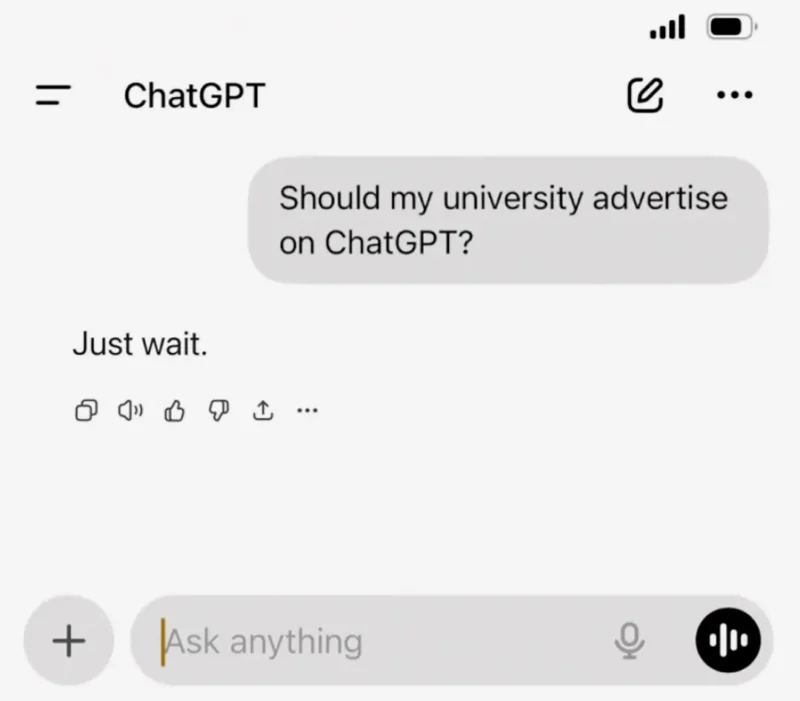
Our take is simple: Just wait.
FAQ: ChatGPT ads for universities.
Should universities advertise on ChatGPT right now?
At this stage, ChatGPT ads are running as a pilot, with limited measurement and high reported costs. For institutions focused on enrollment outcomes, there may be stronger, more measurable alternatives available. Our recommendation is to wait until the model matures.
How much do ChatGPT ads cost?
Early reports suggest pricing around $60 CPM, with a high minimum commitment. That structure positions ChatGPT ads as a premium awareness buy rather than a performance-driven channel.
Can universities reach undergraduate prospects with ChatGPT ads?
No. Ads do not appear to users under 18 years old. For institutions focusing on traditional undergraduate recruitment strategies, that limitation is significant.